Andrew Sullivan is on vacation, but he left his blog in good hands. This is a useful look at the McCain campaign's clumsy and dishonest statement about Obama's visit to Yad Vashem.
It seems to me that Obama is one of the last politicians you'd want to attack when it comes to genocide. In addition to having earned a solid reputation of being a strong advocate for ignored human rights crises, he's got one of the top authorities on genocide and U.S. foreign policy, Samantha Power, among his top advisers. (By the way, Power's Pulitzer Prize-winning book on genocide and U.S. foreign policy is a must-read.) If you're a political news junkie, you'll recall that Professor Power resigned from the campaign after making some controversial remarks about Senator Clinton. Politics might keep her out of the spotlight for a while, but she's an absolutely brilliant and essential voice among U.S. foreign policy experts, and I doubt she's very far removed from the campaign today - even if her role is slightly less public for the time being.
But I digress. How about that statement?
Wednesday, July 23, 2008


Saturday, July 19, 2008
When Did We Lose It?
Pondering opposition to Al Gore's climate and energy initiatives, Bob Herbert asks the crucial question:
When exactly was it that the U.S. became a can't-do society? It wasn't at the very beginning when 13 ragamuffin colonies went to war against the world's mightiest empire. It wasn't during World War II when Japan and Nazi Germany had to be fought simultaneously. It wasn't in the postwar period that gave us the Marshall Plan and a robust G.I. Bill and the interstate highway system and the space program and the civil rights movement and the women's movement and the greatest society the world had ever known.I would argue that we haven't become a can't-do society - at least not in any permanent sense. Gore's goals for transforming our approach to the environment, sustainable energy, and petro-security aren't met with opposition because of low national morale. The problem is political. The scientific consensus behind global warming is fact. The economic benefits of sustainable energy and decreased oil imports are well-documented. The security argument is a familiar and correct one. But partisan politics puts blinders on all of these things, because some people just don't like Al Gore. And they will ignore science, economics, and American security interests to continue fighting political battles against him.
Friday, July 18, 2008
Grouchy Old Crank
Charles Krauthammer supplies enough spite for the entire Washington Post Op-Ed page this morning:
I propose an effort to improve Krauthammer's mood. This sort of grumpiness is awfully unbecoming.
Obama is a three-year senator without a single important legislative achievement to his name, a former Illinois state senator who voted "present" nearly 130 times. As president of the Harvard Law Review, as law professor and as legislator, has he ever produced a single notable piece of scholarship? Written a single memorable article? His most memorable work is a biography of his favorite subject: himself.There are plenty of assertions here to disagree with (especially the claim about legislative achievements), but the overall tone of this piece is so grouchy that I can't imagine anyone taking it seriously as a political argument. Especially with a statement like this:
After all, in the words of his own slogan, "we are the ones we've been waiting for," which, translating the royal "we," means: " I am the one we've been waiting for."It's a nice trick - invoking the royal "we" to dodge the silver bullet which strikes the heart of the argument. Obama has always said that change must come from the bottom up. He says again and again in his speeches that the movement is not about him, but about the millions of supporters who have joined his campaign. And the phrase "we are the ones we've been waiting for" is a perfect expression of that sentiment. But none of this matters if you're a crabby columnist who intentionally misreads statements in order to advance a theory with gaping logical holes.
I propose an effort to improve Krauthammer's mood. This sort of grumpiness is awfully unbecoming.
Thursday, July 17, 2008
Missing the Point About Missing the Point
Matthew Yglesias and Glenn Greenwald take aim at Thomas Friedman's column from yesterday, basically calling him foolish for allegedly not understanding why America is widely disliked in the world. They're both misreading what Friedman actually said.
First, Yglesias misstates the thesis of the piece:
There's a brief bright spot right after Yglesias's opening salvo, but then the post descends a second time into misreadings and poor reasoning.
I'm less surprised about Glenn Greenwald. Now, Matthew Yglesias and Glenn Greenwald are both intelligent, but Greenwald is awfully preachy, so you can expect this sort of thing from time to time (even when he's right, which in this case he is not). Let's get to what he said:
There's a terrible trend in our politics that I was discussing with someone the other day. We have a tendency to canonize people who were right on one or two important issues and to alienate people who were wrong on one or two important issues. How's this for a change: we embrace the idea that sometimes people make bad judgments or say dumb things, but - absent an obvious trend - their overall judgment might not be totally flawed. Someone who was wrong about Iraq could be right about things in the future, and someone who was right about Iraq could be wrong about things in the future. I sense that this sort of attack is the left's retaliation against Friedman for being pro-war in 2003. It would be a big mistake to discount the insight and intelligence of Friedman; he's been a consistent and effective advocate for many liberal policies, and his writing about the Middle East (particularly From Beirut to Jerusalem) is top-notch. It's time to let him out of the dog house, and we can start that process by listening to fewer self-important ranters like Glenn Greenwald.
First, Yglesias misstates the thesis of the piece:
Tom Friedman is really pissed off that people around the world take a dim view of the United States even though despite our flaws our government is less repressive than China's and we've had a much more constructive policy toward Zimbabwe than has South Africa. One wonders if he really doesn't understand this, but it's the hegemony, stupid.Of course Friedman understands that it's the hegemony. That's why he said this:
Maybe Asians, Europeans, Latin Americans and Africans don't like a world of too much American power — "Mr. Big" got a little too big for them.So, given that Friedman points out exactly what Yglesias said he didn't understand, I can't imagine where Yglesias is coming from. Unfortunately, this slip-up is just one of many in Yglesias's post - one that has an uncharacteristically casual relationship with reality and logic.
There's a brief bright spot right after Yglesias's opening salvo, but then the post descends a second time into misreadings and poor reasoning.
America has long sought to play a global leadership role, and under Bush has sought to play this role almost exclusively through methods of coercive domination. Under those circumstances of course America's sins and flaws look exaggerated. We can write self-congratulatory newspaper columns whining about this, or else we can try to put our policies and our position in the geopolitical structure on a more sustainable basis.Ok, so the first two sentences are correct - and, in fact, are part of Friedman's argument anyway. But Yglesias's conclusion is just wrong. Putting aside the fact that Friedman has written several columns about sustainable, responsible foreign policy for the U.S., the column is neither self-congratulatory nor whiny. In fact, it was insightful. Friedman's point is not that the U.S. is unfairly disliked, it's that a world with too little U.S. power is worse than a world with too much U.S. power, because the leadership vacuum left by U.S. decline could be filled by emerging superpowers whose policies are considerably nastier. Is he chastising the world for being bothered by Abu Ghraib and Guantanamo Bay? No - he's responding to this finding:
Polls tell us how China is now more popular in Asia than America and how few Europeans say they identify with the United States.Friedman's response, understandably, is that people who prefer Chinese leadership should be careful what they wish for. It's a reasonable point, and I remain surprised that Yglesias - whose commentary is normally incisive and intelligent - totally missed the point.
I'm less surprised about Glenn Greenwald. Now, Matthew Yglesias and Glenn Greenwald are both intelligent, but Greenwald is awfully preachy, so you can expect this sort of thing from time to time (even when he's right, which in this case he is not). Let's get to what he said:
Tom Friedman is befuddled. He cannot understand "the decline in American popularity around the world under President Bush" and is specifically upset about the fact that "China is now more popular in Asia than America and how few Europeans say they identify with the United States."See the tricky thing Glenn did there? He lied about Friedman's thesis by saying that he "doesn't understand" and "is befuddled," even though Friedman has a laundry list of U.S. screw-ups in the first paragraph of his column. Then he made it sound like Friedman is specifically confused about dislike for President Bush, which is less of a lie and more of a deliberate misrepresentation, since it makes Friedman sound like a Bush fan, even though his disapproval of Bush is no secret. Way to go, Glenn! But that's not all:
Friedman generously allows that "[a]n America that presides over Abu Ghraib, torture and Guantánamo Bay deserves a thumbs-down" -- a "thumbs-down": what a playful movie critic says about a boring film. In listing America's small imperfections that have caused this worldwide unpopularity, Friedman forgot to mention America's invasion and occupation of Iraq, which Friedman himself cheered on.Oops! Turns out that Glenn, by this point, is just making shit up! Let's have another look at the column in question, which supposedly omits Iraq:
We should have done better in Iraq.See that? That's a direct quote. In fact, it's the fourth sentence in the column, so if you read for more than 8 seconds, you probably saw it. I know I did, which is why I thought, "Hmm! That's not true!" when reading Glenn Greenwald this morning. Could Friedman have elaborated on that point? Well, maybe, but seeing as he's written about 1,549 columns about the failure of the Iraq War - and space is limited to make his point about American vs. Chinese power - I can forgive him. But Glenn can't, because he's still pissed about a single dumb remark Friedman made five years ago. Then Glenn works himself into an even preachier rage because John McCain can be a jerk sometimes:
What other country in the world has leading members of its political class who justify unprovoked attacks on other countries -- who casually justify the deaths of hundreds of thousands of innocent people -- in such depraved and sadistic terms? And, for that matter, what other country has a leading presidential candidate who sings songs about bombing another country and who continues to joke openly about killing its citizens?I'd address the rest of Greenwald's screed, but I think you get the idea. Blah blah blah, Tom Friedman is the same as George W. Bush, he's caused the deaths of thousands of people, he's a warmonger, etc. The faulty associations with Bush aside, the whole rant is based upon a totally wrongheaded approach to what Friedman actually said in yesterday's column.
There's a terrible trend in our politics that I was discussing with someone the other day. We have a tendency to canonize people who were right on one or two important issues and to alienate people who were wrong on one or two important issues. How's this for a change: we embrace the idea that sometimes people make bad judgments or say dumb things, but - absent an obvious trend - their overall judgment might not be totally flawed. Someone who was wrong about Iraq could be right about things in the future, and someone who was right about Iraq could be wrong about things in the future. I sense that this sort of attack is the left's retaliation against Friedman for being pro-war in 2003. It would be a big mistake to discount the insight and intelligence of Friedman; he's been a consistent and effective advocate for many liberal policies, and his writing about the Middle East (particularly From Beirut to Jerusalem) is top-notch. It's time to let him out of the dog house, and we can start that process by listening to fewer self-important ranters like Glenn Greenwald.
Great News
From Andrew Sullivan: the HIV travel ban is gone. He's been working hard (and enlisting the support of his many readers) to get rid of this terrible provision, and it looks like the battle is finally over.
This is the best way to deal with the legacy of Jesse Helms: unraveling it piece by piece. The Senate lifted a huge burden for many people today.
This is the best way to deal with the legacy of Jesse Helms: unraveling it piece by piece. The Senate lifted a huge burden for many people today.
Tuesday, July 15, 2008
The Benefit of the Doubt
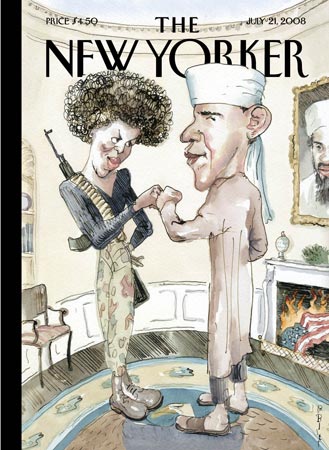
Jack Shafer, unsurprisingly, is exactly right about the dumb controversy surrounding the illustration on the cover of The New Yorker:
Calling on the press to protect the common man from the potential corruptions of satire is a strange, paternalistic assignment for any journalist to give his peers, but that appears to be what The New Yorker's detractors desire. I don't know whether to be crushed by that realization or elated by the notion that one of the most elite journals in the land has faith that Joe Sixpack can figure out a damned picture for himself.This makes me think of a great line from Voltaire. "I have never made but one prayer to God, a very short one: 'O Lord, make my enemies ridiculous.' And God granted it." Let's not forget how ridiculous these people are by playing down to their level. People really can understand nuance and satire.
Navigating the Tubes
In an interview from Sunday's New York Times, John McCain tells what has to be a little lie:
There's not a lot to learn. You click on an icon that says "Internet," and voilà! Not much of a surprise, though. Of course, The Onion was on this story months ago:Q: But do you go on line for yourself?
Mr. McCain: They go on for me. I am learning to get online myself, and I will have that down fairly soon, getting on myself. I don't expect to be a great communicator, I don’t expect to set up my own blog, but I am becoming computer literate to the point where I can get the information that I need – including going to my daughter's blog first, before anything else.
"All you have to do to turn the website on is put the little blinking line thing in the cyberspace window at the top of the screen, type 'thegoogle.com,' and press 'return'—although it will also recognize http.wwwthegoogle.com, google.aol, and 'THEGOOGLE' typed into a Word document."
Wednesday, July 9, 2008
Bait for the Xenophobes
Sean Hannity is already on this, and I can't imagine the others are far behind. "Obama wants to make our children speak Spanish! This must be stopped!" They'll find a way to make this rather benign observation seem threatening - probably by forcing it into the right-wing storyline that Obama is foreign, elitist, and "embarrassed" by Americans.
Of course, his comment is true; while Americans benefit from speaking the lingua franca, learning another language is a rewarding endeavor. It's a wonderful way to gain appreciation of other cultures, to say nothing of the benefit of being able to communicate with whole new groups of people.
When was the last time President Bush asked anything of Americans? Obama's asking us to embrace nuance in our politics, to learn new languages, and to perform community service. Let the wingnuts attack all they want. This is what leadership looks like.
Of course, his comment is true; while Americans benefit from speaking the lingua franca, learning another language is a rewarding endeavor. It's a wonderful way to gain appreciation of other cultures, to say nothing of the benefit of being able to communicate with whole new groups of people.
When was the last time President Bush asked anything of Americans? Obama's asking us to embrace nuance in our politics, to learn new languages, and to perform community service. Let the wingnuts attack all they want. This is what leadership looks like.
Why I Love D.C., Part II
A wonderful exhibit currently at the Hirshhorn: The Cinema Effect: Illusion, Reality, and the Moving Image. It runs until September 7 and is, of course, free. I particularly enjoyed Christian Jankowski's 2003 film "This I Played Tomorrow," which is scripted from a series of interviews the filmmaker conducted. The interviews play on monitors on the side of the room while you watch the final product, which is brilliantly staged and acted. The interview snippets become an engaging commentary and meditation on the power (or lack thereof) of art, inviting the viewer to ponder the ability of art, particularly cinema, to provide salvation, truth, or transcendence. One character, a mother grieving the recent death of her adult son, tells the other characters about his musical talents and declares, "I can sing too." She begins to sing for the people gathered and reflects on the comfort of heaven and the afterlife. Another character bluntly declares that cinema cannot express truth - only emotions. "I want to express astonishment at human beings," he says.
The other piece that struck me was "Mother+Father," an installation by Candace Breitz that spans two rooms and twelve monitors. Breitz took six mothers and six fathers from popular Hollywood movies, placed them in front of plain black backgrounds, and used portions of their dialogue to create conversations about motherhood and fatherhood. The five mothers discuss femininity, their own mothers, and mother/daughter relationships among themselves. The five fathers discuss masculinity, divorce, and the difficulty of watching their daughters become grown women. The conversations - carefully arranged by the artist - are often absurd, occasionally hilarious, and sometimes very sad. You can watch them at the artist's website, but if you can make it to the Hirshhorn to see the full installation, it's definitely worth your time.
The other piece that struck me was "Mother+Father," an installation by Candace Breitz that spans two rooms and twelve monitors. Breitz took six mothers and six fathers from popular Hollywood movies, placed them in front of plain black backgrounds, and used portions of their dialogue to create conversations about motherhood and fatherhood. The five mothers discuss femininity, their own mothers, and mother/daughter relationships among themselves. The five fathers discuss masculinity, divorce, and the difficulty of watching their daughters become grown women. The conversations - carefully arranged by the artist - are often absurd, occasionally hilarious, and sometimes very sad. You can watch them at the artist's website, but if you can make it to the Hirshhorn to see the full installation, it's definitely worth your time.
Subscribe to:
Posts (Atom)

 Posts
Posts